Articles
AI in HR: Real ROI Over the Past Year
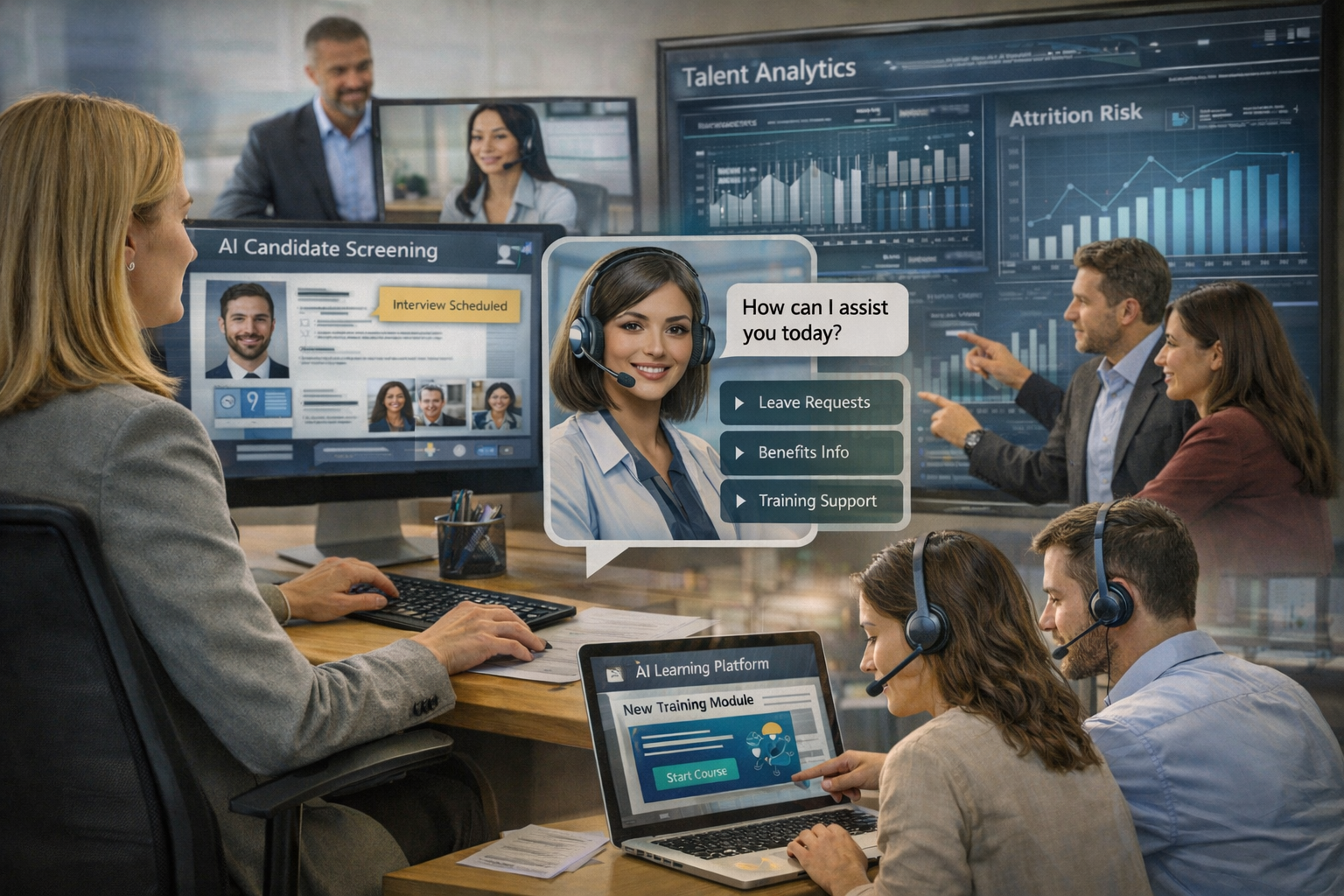
AI in HR: Real ROI in 2025
Over the past year, AI in HR has moved from "promises" to measurable impact: in real-world cases, companies are cutting hiring cycles by tens of percent, saving hundreds of thousands and even tens of millions of dollars annually, and redirecting thousands of person-hours from routine to higher-value work. The highest ROI today comes from four areas: recruiting automation, HR chatbots and virtual assistants, predictive talent analytics, and AI-powered learning & development.
AI in HR: ROI by Direction
- 🎯 · Recruiting · up to 50% · time-to-hire reduction (Deloitte) · 20–40% lower cost-per-hire (SHRM)
- 💬 · HR Chatbots · 30–60% · fewer repetitive HR queries · Up to 75 min/day saved per employee
- 📊 · Predictive Analytics · 41% · better hiring outcomes (SHRM Labs) · 38% lower regrettable turnover
- 📚 · L&D Automation · 60% · of L&D tasks automatable by AI · 340% avg ROI within 18 months (Nucleus)
1. Recruiting: When AI Translates Into Budget Savings
Recruiting was the first area where AI's impact is visible "on the calculator." By automating screening, interview scheduling, candidate communications, and job description creation, companies reduce time-to-hire by 30–70% while processing more relevant candidates without growing recruiter headcount. Where staffing agencies are heavily used, AI tools cut cost-per-hire by 30–50%, delivering technology ROI within months through reduced agency fees.
AI in Recruiting: Key Metrics
| Metric | Before AI | After AI | Impact | Source |
|---|---|---|---|---|
| Time-to-hire reduction | Industry avg | With AI screening | up to 50% | Deloitte, 2024 |
| Cost per hire savings | $4,700 avg | AI-automated | 20–40% lower | SHRM, 2024 |
| Recruiter time saved weekly | Manual tasks | AI-assisted | 4–8 hrs/wk | HeroHunt, 2024 |
| AI recruiting ROI | — | Within 18 months | 340% | Nucleus Research |
| Enterprise annual savings | — | 1,000+ employees | $2.3M/yr | Deloitte, 2024 |
| HR pros reporting time savings | — | — | 89% | SHRM, 2025 |
Practical figures show that savings are expressed not only in percentages but in concrete person-hours and money. In one AI recruiting implementation for technical roles, a company shortened its hiring cycle from 24 to 10–12 days and freed 200–300 person-hours per month previously spent on manual test and resume reviews. In another example, automating interviews and application processing saved 70,000 hours per year and approximately £1 million in direct costs — a true scale effect in a large organization. Analysts also show that over 90% of companies that deployed AI in recruiting report tangible productivity gains, with some seeing recruiting efficiency increase by 30% or more.
2. HR Chatbots & Virtual Assistants: The New HR Service Front
The second wave of practical impact comes from HR chatbots and virtual assistants for employees. They answer routine questions (from leave policies to benefits), help navigate company policies, initiate HR processes, and find resources without human intervention. Research shows that deploying such assistants reduces repetitive HR queries by 30–60% and radically accelerates information access: time to find the right answer can decrease by 95%.
HR Chatbot Impact Metrics
- 73% · Use chatbots for screening · Deloitte Human Capital, 2024
- 68% · Chatbots for FAQ responses · Deloitte Human Capital, 2024
- 75 min · Saved per employee/day · With active AI assistant usage
- <24h · Candidate response time · Down from 7 days (Gartner, 2024)
Major vendors report impact at the individual productivity level too. Employees actively using AI assistants in HR systems save an average of up to 75 minutes of work time per day, redirecting it to more meaningful tasks. In a practical virtual HR assistant case, the share of repetitive queries reaching the HR team dropped by 68% within three months, and HR professionals freed over 10 hours per week that can be invested in analytics, manager development, and process change instead of responding to tickets. At company level with about a thousand employees, even 30 minutes saved per employee per day translates to tens of thousands of hours per year, equivalent to hundreds of thousands in currency when converted to labor cost.
3. Predictive Talent Analytics: From Intuition to Measurable Impact
AI models in HR have moved beyond reporting and are increasingly used for forecasting: attrition risk, hiring success probability, headcount planning, and budgets. In several cases, predictive analytics combined with improved processes led to double-digit reductions in voluntary turnover while simultaneously cutting time-to-fill positions. This is particularly significant for roles with high replacement costs, which can easily reach 50–200% of annual salary.
Predictive Analytics: Where AI Saves
- 🔮 · Better Hiring Outcomes · 41% improvement in hiring quality with predictive analytics (Workday/SHRM Labs, 2024)
- 📉 · Lower Regrettable Turnover · 38% reduction in unwanted attrition through early risk detection (SHRM Labs, 2024)
- 💵 · Replacement Cost · 50–200% of annual salary per departure — each prevented exit saves this amount
- 🏢 · Enterprise Impact · $2.3M average annual savings for organizations with 1,000+ employees (Deloitte, 2024)
One of the most telling examples: a large organization that implemented an AI-driven approach to HR process management and analytics estimated a total economic impact of $107 million over one year, accounting for optimized recruiting, retention, and talent development. The key insight is that savings come not from "cutting HR" but from more precise resource allocation: the company reduces unnecessary hires, fills critical positions faster, targets at-risk groups for turnover, and thereby reduces indirect losses from unfilled positions and departure of key people.
4. Learning & Development: AI as the Hidden Productivity Driver
L&D has traditionally been considered a cost center: course creation, training delivery, platform administration. Over the past 12–18 months, AI has significantly changed the economics of this function. Research shows that up to 60% of typical L&D tasks (content generation, test creation, audience adaptation, initial personalization) can be automated with AI tools. This shortens time-to-launch for new training and reduces the need for external contractors and manual course development.
AI Adoption by HR Task (SHRM, 2025)
- Job descriptions (AI-generated) · 66% · SHRM, 2025
- Content generation for L&D · 60% · Industry avg
- Resume screening automation · 44% · SHRM, 2025
- Candidate sourcing automation · 32% · SHRM, 2025
- Applicant communications · 29% · SHRM, 2025
An additional source of impact is shifting learning from "scheduled courses" to "learning in the flow of work" via AI prompts and assistants. Instead of pulling employees into multi-hour sessions, companies deploy micro-prompts and interactive hints directly within work systems, reducing direct time costs and increasing the likelihood of applying knowledge in practice. In monetary terms, the savings come from reducing the content budget, cutting the hours employees spend away from their work, and helping people reach target productivity faster, although the specific amounts here depend more heavily on the scale of the business and the types of roles.
5. Where the Market Is Heading: AI Layer in Platforms Instead of "Toys"
The key trend of recent months: companies are moving away from point "toys" and increasingly deploying AI as a layer within existing HR platforms. Major HCM and recruiting solutions — from SAP SuccessFactors and Workday to specialized recruiting systems — are actively embedding AI features: automatic job description generation, intelligent candidate search and matching, personalized manager dashboards, and HR copilots for employee questions. This lowers adoption barriers: companies can achieve measurable impact without radical infrastructure changes.
Platform Evolution: From Tools to Ecosystem
- 1 · Point Tools · Standalone AI apps for single tasks · Declining
- 2 · Embedded AI · AI features built into existing HR platforms (69% adoption — SHRM) · Dominant
- 3 · AI-Native Ecosystem · Unified platform where AI is the core layer (81% projected by 2027 — Gartner) · Emerging
Yet the market still has many niche AI solutions — from recruiting chatbots to specialized analytics engines — but practice shows that the most sustainable and largest economic impact comes from integrated scenarios. Where AI is connected to recruiting, onboarding, performance management, and learning within a single ecosystem, it's easier to measure ROI, scale successful cases, and avoid chaos from disconnected tools. For the HR function, this means a shift in focus: from choosing "yet another tool" to designing a target process model where AI becomes a mandatory component.