Articles
HR Functions by 2031: The Global AI Transformation
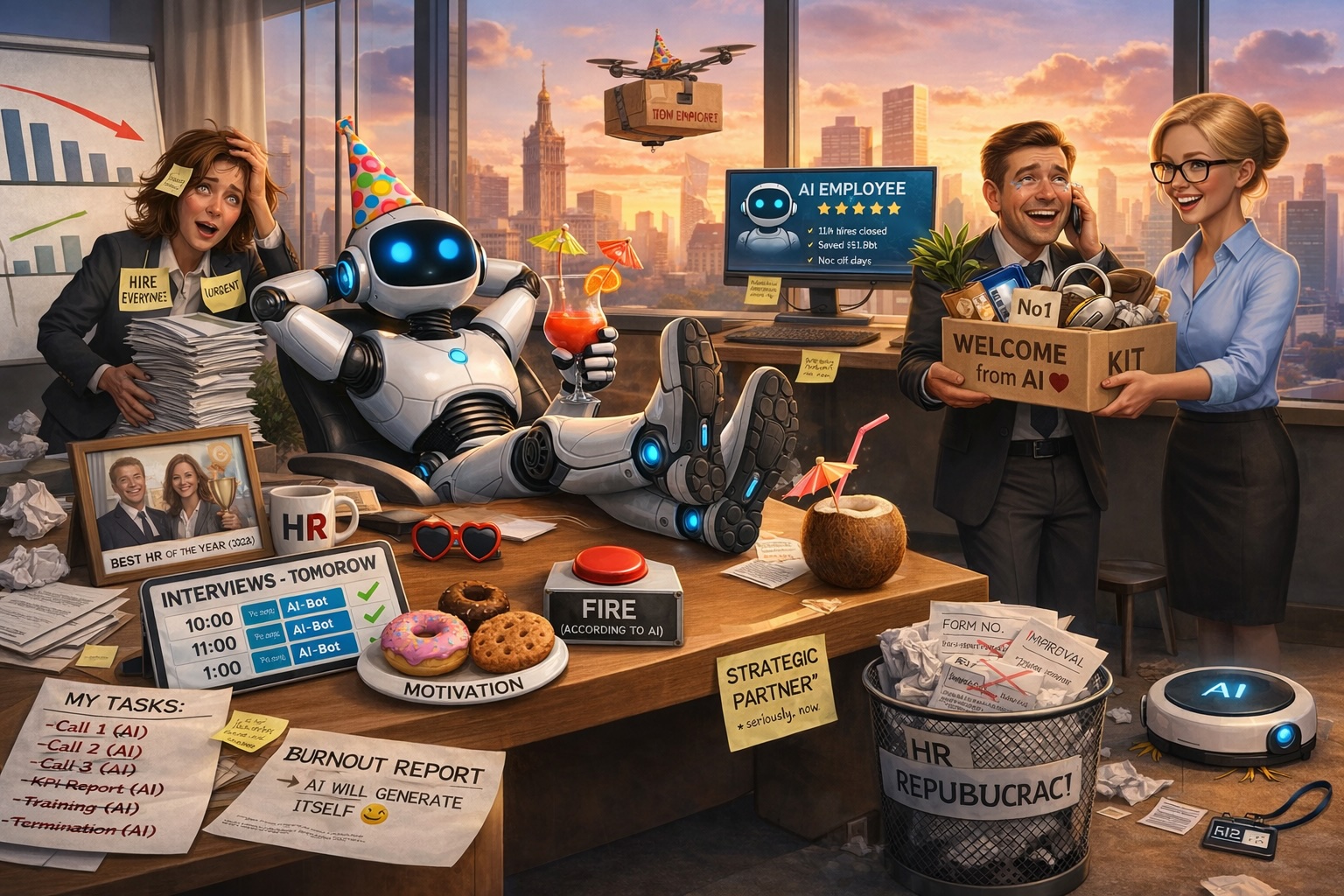
By 2031, artificial intelligence will radically reshape the HR function worldwide. According to Grand View Research, the global AI in HR market will grow from ₽325 billion to ₽1.5 trillion by 2030 (CAGR 24.8%). Gartner forecasts that by 2030, 60% of all HR tasks will be performed by AI agents or LLM interfaces.
The World Economic Forum (Future of Jobs Report 2025) expects 92 million jobs to disappear while 170 million new ones emerge (net +78 million), with 59% of the global workforce requiring reskilling. McKinsey estimates that AI will automate up to 30% of working hours by 2030.
HR automation forecast by 2030 (Gartner / McKinsey / WEF)
- Recruitment · 90%
- Admin & Payroll · 95%
- L&D · 80%
- Performance Mgmt · 70%
- C&B · 75%
- People Analytics · 65%
Source: Grand View Research — AI in HR market to grow from 325 billion ₽ to 1.5 trillion ₽ by 2030 (CAGR 24.8%)
This is not the end of HR — it's the end of bureaucratic, routine HR. The function will transition from administrative support to strategic business architect. Below is an analysis of all key HR functions with global data, forecasts, and risks.
1. Recruitment and Talent Acquisition
Today, recruitment is one of the most labor-intensive functions: average time-to-hire is 42–60 days, cost per hire ₽400–600K at large companies. Already 43–51% of companies use AI for resume screening and matching (Gartner 2025).
By 2031, 80–90% of routine tasks — screening, initial interviews, scheduling — will be handled by AI agents. Humans will remain only for final candidate selling, complex C-level positions, and relationship building.
Recruitment: 2026 vs 2031
| Metric | 2026 | 2031 | Effect |
|---|---|---|---|
| Time-to-hire (mass) | 45–60 days | 10–15 days | −70–75% |
| Cost per hire | 400–600 thousand ₽ | 150–250 thousand ₽ | −60% |
| Application → Offer | 8–12% | 20–28% | +120–150% |
| Recruiters per 1,000 | 4–6 | 1.5–2 | 2–3× reduction |
Unilever's AI platform reduced time-to-hire by 75% and saved 50,000 recruiter hours. PepsiCo increased diversity by 30%.
Risks: algorithmic bias (mandatory audits needed). New recruiter skills: value selling, AI ethics, business acumen.
2. Learning and Development
Traditional L&D means group training 1–2 times per year, 35–45% engagement, budget ₽120,000–200,000 per employee. 59% of the global workforce will need reskilling by 2030 (WEF).
By 2031, AI will create personalized real-time learning tracks based on skills, goals, and business needs. Every employee will have a personal AI coach 24/7. Learning effectiveness will increase by 23–40%, knowledge retention by 17% (McKinsey).
Learning & Development: 2026 vs 2031
| Metric | 2026 | 2031 | Effect |
|---|---|---|---|
| Training format | Group sessions | Personal AI tracks | +80% engagement |
| Cost per employee | 120–200 thousand ₽ | 40–80 thousand ₽ | −50–60% |
| Skill-gap closure | 6–12 months | 2–4 months | 3× faster |
| Knowledge retention | 65–75% | 85–92% | +20–25% |
IBM Watson Talent showed a 25% increase in engagement. Accenture implemented personalized learning paths for 700,000 employees.
Risks: loss of human interaction, digital inequality. L&D specialist skills: AI content design, real-time ROI measurement.
3. Performance and Talent Management
Currently, performance reviews are annual, subjective, and low-accuracy. Talent management relies on manual succession planning.
By 2031, AI will deliver real-time feedback, predict turnover with 85–90% accuracy, and automatically build succession pipelines. 70% of performance management tasks will be automated. McKinsey: +30% productivity through continuous feedback.
Performance Management: 2026 vs 2031
| Metric | 2026 | 2031 | Effect |
|---|---|---|---|
| Review frequency | 1–2× per year | Quarterly / monthly | Continuous |
| Turnover prediction | 50–60% | 85–92% | +50% accuracy |
| Succession planning | Weeks | Hours | 10× faster |
| Feedback engagement | 40–50% | 80–90% | +80–100% |
Adobe switched to check-ins instead of annual reviews. Google uses AI-powered goals and feedback.
Risks: over-reliance on data, demotivation. New skills: AI insight interpretation + coaching.
4. Compensation and Benefits
C&B involves manual benchmarking, benefits administration, and low personalization. 73% of employees are willing to stay for personalized packages (HUB International 2025).
By 2031, AI will dynamically adjust salaries monthly based on market data + performance, and personalize benefits (health, wellness, learning budgets). Savings of 30–40%, payroll errors −90%.
Compensation & Benefits: 2026 vs 2031
| Metric | 2026 | 2031 | Effect |
|---|---|---|---|
| Benefits personalization | 20–30% | 80–95% | +200% |
| Payroll errors | 5–8% | <1% | −90% |
| Benchmarking time | Days / weeks | Seconds | 100× faster |
| Retention via C&B | +15–20% | +30–40% | 2× impact |
5. Employee Experience and Wellbeing
Burnout affects 1 in 5 employees globally (McKinsey Health Institute). By 2031, burnout scores and stress indices will be part of CEO and CHRO KPIs. AI coaches, wearables, and predictive analytics will prevent burnout.
Key employee wellbeing metrics
- 77% · Ready for AI wellness · Employees open to AI mental health tools
- 4:1 · Wellness ROI · Return on wellbeing program investments
- 59% · Need reskilling · Global workforce requiring retraining by 2030 (WEF)
6. HR Administration and Compliance
Administration takes up to 40% of HR time. By 2031, 95–100% of documents, payroll, and compliance monitoring will be fully automated. Staff will be reduced 4–5×, errors −90%.
HR Admin & Compliance: 2026 vs 2031
| Metric | 2026 | 2031 | Effect |
|---|---|---|---|
| Document automation | 40–50% | 95–100% | Full auto |
| Payroll processing | Days | Minutes | 100× faster |
| Compliance violations | 5–10% | <0.5% | −90–95% |
7. People Analytics and HRBP
HRBPs today are often administrative. By 2031, they'll be strategic talent architects with unit economics, AI governance, and strategic influence. Gartner and Deloitte: HRBPs will lead workforce redesign with a ratio of 1:800–1,200 employees.
People Analytics & HRBP: 2026 vs 2031
| Metric | 2026 | 2031 | Effect |
|---|---|---|---|
| HRBP strategic influence | 30–40% | 70–85% | +100% |
| People Analytics adoption | 35–45% of companies | 90%+ | 2× growth |
| HRBP per 1,000 employees | 3–5 | 1–1.5 | 3× reduction |
Conclusion: What to Do Today
By 2031, HR will stop being a cost center and become a value driver with direct strategic impact. Administrative roles will shrink by 40–60%, while strategic HRBPs, analytics, and talent architects will grow in value.
What HR professionals should do today
- 📊 · Data Literacy · Master unit-economics and AI tools (ChatGPT, Claude, enterprise platforms)
- 🎯 · Business Outcomes · Shift from processes to business results and talent value proposition
- 🤖 · Human-Centric AI · Implement AI with ethical guidelines and human oversight
- 📚 · Lifelong Learning · Skills half-life is only 2 years — continuous development is essential
Those who today understand business, count money, and sell talent will be worth their weight in gold. The era of bureaucratic gatekeepers is over. The age of HR architects of the future has begun.
Are you ready for 2031?