Articles
Global HR Metrics and Trends for 2026
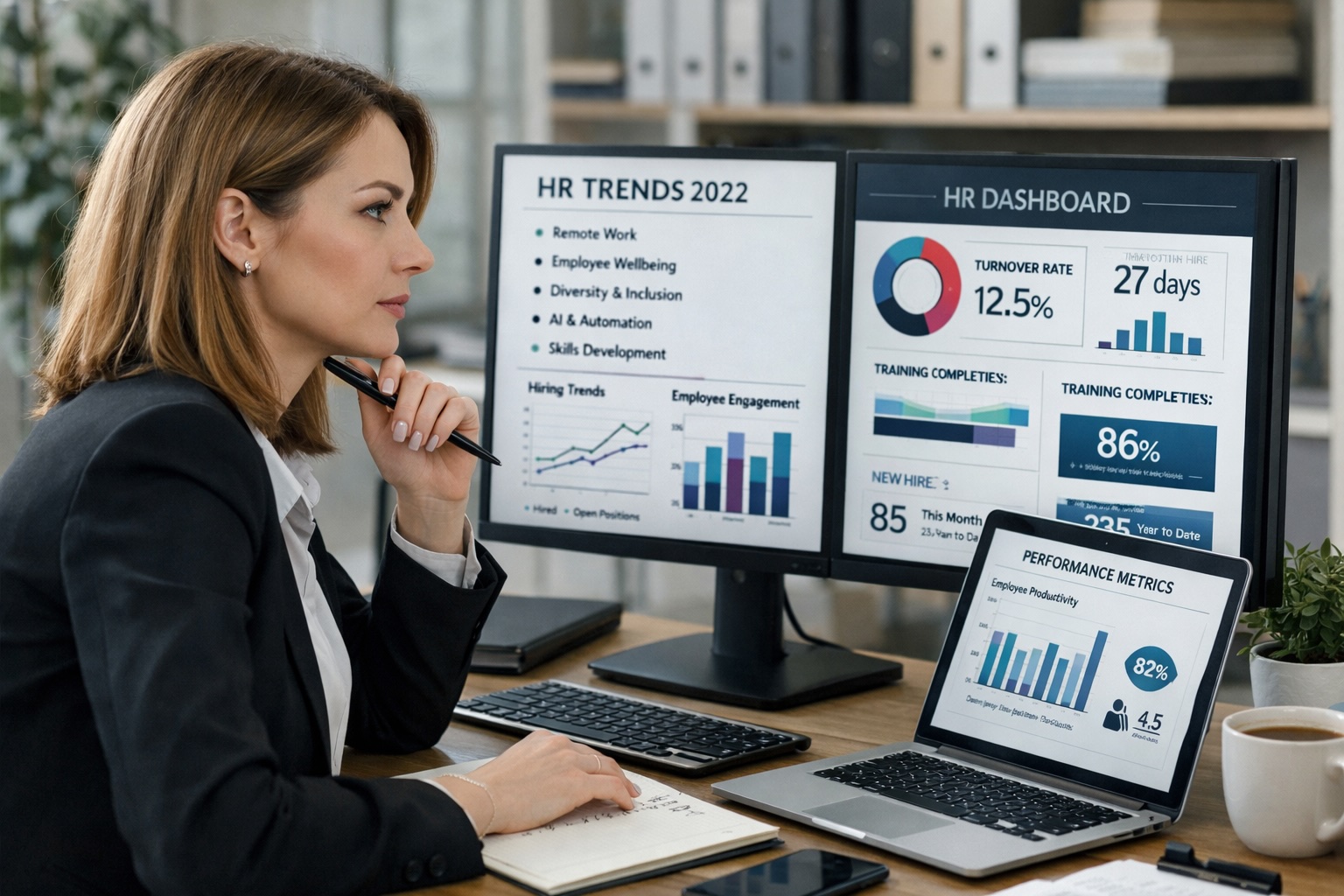
The year 2026 cements HR’s status as a strategic player responsible not only for people and processes, but also for the architecture of work itself. Artificial intelligence, a skills-based approach to talent management, global hiring and a systematic approach to wellbeing are coming to the forefront.
Key Global HR Metrics
Current research finds that companies’ competitiveness depends less and less on scale and increasingly on the speed of adaptation and the quality of management decisions. Global reviews identify several major shifts.
A Focus on Productivity Through Reconfiguring Work
Organizations are moving from isolated cost optimization to redesigning processes: roles, value chains and the interaction between people and technology are being reassessed.
Skills Shortages and the Global Talent Market
More than half of companies plan to increase the share of international hires, using remote work to close “skill gaps” and optimize the cost of talent.
- The rapid obsolescence of skills. According to major consolidated reviews, around 44% of workers’ current skills will be substantially transformed or partially lost over a five-year horizon under the influence of technology and AI.
- The balance between job destruction and job creation. Automation and digitalization are displacing tens of millions of roles while creating new jobs that require digital, analytical and “human” skills: critical thinking, cross-functional collaboration and leadership.
Engagement and stress are becoming strategic metrics. Global labor market reports note growing attention to levels of stress, burnout and engagement: these indicators are already being discussed by boards of directors and investors.
Main HR Trends for 2026
1. AI as a Co-Designer of Work
Artificial intelligence is moving beyond experiments in individual functions and becoming a “cross-cutting technology” across HR. Companies use AI not only to automate routine tasks, but also to rethink how work is organized:
- AI tools are being integrated into recruitment, learning and development, performance management, engagement and internal mobility.
- The emphasis is shifting to predictive analytics: forecasting turnover, burnout risk, scenarios for closing skills gaps and modeling the impact of organizational changes.
- An AI governance agenda is emerging: managing the risks of discrimination, opaque algorithms and data leaks, and complying with regulatory requirements in different countries.
2. Skills-Based HR Instead of Job Matrices
Instead of the traditional “job — department — level” logic, more and more companies are shifting to management through skills. This changes approaches to hiring, development, assessment and rewards:
- Companies are building skills maps and competency profiles that become the foundation for recruitment, upskilling and reskilling.
- Skills-based models increase internal mobility: employees move more often between roles and projects, rather than only up a vertical career ladder.
- Performance assessment is linked to the use and development of key skills, rather than only to meeting formal KPIs.
3. Hybrid Work and Distributed Teams as the Standard
Hybrid and remote work are firmly becoming the default way of working, especially in knowledge-intensive industries. This strengthens HR’s role in managing distributed teams and the international dimension of work:
- Organizations are developing hybrid work policies, paying attention to productivity, data security, and tax and labor risks across jurisdictions.
- The importance of the digital employee experience is growing: collaboration tools, asynchronous communication, and transparency around goals and results.
- Leaders are being trained to manage distributed teams: setting tasks, providing feedback, measuring performance and supporting engagement at a distance.
4. Wellbeing as Part of the Infrastructure
Employee wellbeing is evolving from a collection of separate programs into an element of organizational design:
- Employers are reassessing not only the “benefits package,” but also how workloads, work schedules and management practices are structured.
- Workload management, flexible schedules, mental health support, the quality of the environment and the culture of interaction are coming into focus.
- Wellbeing metrics are being included in regular management reporting alongside financial and operational indicators.
Companies view health and psychological support programs as an investment in reducing turnover and increasing productivity, rather than as a cost.
5. Culture and Trust as a Measurable Asset
Culture is no longer seen as an abstract concept. Organizations seek to measure levels of trust, fairness, inclusion and psychological safety, and link them to business results:
- Regular surveys, feedback analysis, and trust and inclusion indices are becoming part of HR analytics.
- Leaders are assessed not only on their teams’ results, but also on their impact on culture: the quality of communication, fairness of decisions, and how they handle mistakes and conflicts.
A Comparison: HR “Yesterday” and HR in 2026
HR yesterday vs HR 2026
| Area | Before (2023–2025) | New role (2025–2026) |
|---|---|---|
| HR Role | Operational & organizational | Strategic partner, AI-driven models |
| Technology | ATS, basic HRIS | AI copilots, predictive analytics |
| Hiring & Market | Local hiring | Global hiring & distributed teams |
| Performance | Annual reviews & ad-hoc perks | Continuous performance management |
| Compensation | Closed comp package | Total rewards & transparency |
Against the backdrop of these trends, HR departments are transforming from large operational units into compact, technologically equipped teams with strong expertise in data and change. Modern HR combines people skills, management analytics and the project management of transformation.
HR leaders face new requirements: proficiency with digital and AI tools, the ability to read and interpret HR data; the ability to design organizational structures, roles and processes using a skills-based approach; and a willingness to manage change in conditions of high uncertainty.
As a result, HR is becoming one of the key drivers of business resilience and adaptability, shaping exactly how people, teams and the entire organization work in a world where technology and employee expectations are changing faster than ever.